Showing posts with label History. Show all posts

Saturday, 1 August 2020

NOW BRING ME THAT HORIZON!

With the Blood & Plunder "Raise the Black" on the Horizon, I won't lie I'm getting more and more excited - the plastics are looking great.


And frankly ASSUMING they match well in scale with the Metals, I REALLY cannot wait.

Combine that with the fact theres a two-player starter set on the Horizon - the future is VERY bright for Blood & Plunder!

Fuller Information can be found here - https://www.firelockgames.com/raise-the-black-kickstarter/

Sunday, 24 May 2020

THE VASA - AN ALMOST PERFECTLY PRESERVED 17th CENTURY WARSHIP!


The Vasa Warship can be found at the Vasa Museum in Stockholm, Sweden. The ship when built (in 1626) was the most "hi-tech" design when it set sail, unfortunately it sunk in 1628.


It’s believed that the Vasa sank because the gun deck was simply too heavy, and apparently this mistake was the result of it being designed and built by someone with no experience building such a well-armed ship.


It’s so well preserved that it provides a glimpse of life at sea during the 1600’s almost never seen.


The ship was preserved because it sunk in the harbor where it was docked to shelter it from storms. 


The ship was moved to the museum in Stockholm in 1988.


Saturday, 23 May 2020

Captain Morgan for Blood & Plunder

Captain Morgan has always been one of my Favourite Historical Figures.

Sir Henry Morgan born in Wales on the 24th January 1635, Harri Morgan was a Welsh privateer, plantation owner, and, later, Lieutenant Governor of Jamaica. Based in Port Royal, Jamaica - he raided settlements and ships on the Spanish Main, becoming a very wealthy man, eventually purchasing three large sugar plantations.

Morgan died a rich man (on 25th August 1688), and as Lieutenant Governor - was given a State Funeral, and an amnesty was declared so that Pirates and privateers could pay their respects without fear of arrest.

Anyway, this is my Take on the Great Man - Miniature (obviously) by Firelock Games as part of their Blood & Plunder Range.


Tuesday, 5 May 2020

Libertalia - The Pirate Utopia

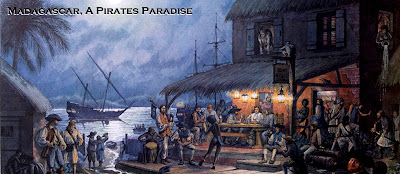
One of the most interesting Tales in Pirate Lore is Libertalia (also known as Libertatia) a Pirate colony founded in the late 17th century in Madagascar by pirates under the leadership of Captain James Misson.


Among Tales told by seafarers in the 17th century were of the strange colony located on the coast of Madagascar - where a brotherhood of Pirates had founded a community, one based on democratic values that lived in peace and harmony - Libertalia lasted for twenty years.


These pirates who settled in Libertalia would be 'vigilant Guardians of the People's Rights and Liberties' and they would stand as 'barriers against the Rich and Powerful' of their day. By waging war on behalf of the Oppressed against the Oppressors, they would see that 'Justice was equally distributed'. These sort of radical ideas were very common in various Pirate-Era celebrations - after the American Revolution, Pirates fleeing from England who got stranded on an island actually started their own Libertatia community. They called their new island 'The Republic of Spensonia', after the fictional Utopian Country created by the English author and Political Reformer Thomas Spence.


All Pirates were against the various forms of Authoritarian Social Constructs of their era - Monarchies, Slavery, and Capitalistic Corruption. Pirates practiced forms of direct democracy, where the people as a whole held the authority to make laws and rules, and used systems of councils with delegates, who were supposed to think of themselves as comrades of the general population.

In spite of their penchant for looting and treasure hunting, pirates were indeed anti-capitalist, they openly opposed to the dispossession that necessarily accompanied the historic ascent of Wage Labor and Capitalism. They insisted that every Man was born free, and had as much Right to what would support him, as to the Air he respired. They resented the encroachments by which Villains (a.k.a. the ruling Classes) and Unmerciful Creditors grew immensely rich as others became poor and wretchedly miserable. They spoke of the 'Natural Right to a Share of the Earth as is necessary for our Support'. The act of Piracy was viewed as a war of self-preservation which looked to redefine the fundamental relations of Property and Power. They had no need for money where every thing was in common, and no hedge bounded any particular man's property, and decreed that the Treasure and Chattels they became owners of through Piracy should be divided equally among their Brothers and Sisters.


Libertalia's motto was 'For God And Liberty' - and its flag was white (in contrast to the black of the Jolly Roger). They were perceived as anarchists by the powers that be, waging war against states and lawmakers, attacking their ships, sparing prisoners, and freeing slaves. They called themselves Liberi, and lived under a communal city rule, a sort of worker owned corporation of Piracy. They had articles (shared codes of conduct), and used elected systems of re-callable delegates.


Judging Pirates by the Imperialist wet Dream that governs our History, not to mention Hollywoods influence - it all seems too fantastic in comparison with what we are told about pirates, that is probably because the historical sources about Libertalia originate in a single book called 'A General History of the Robberies and Murders of the Most Notorious Pirates' by Captain Charles Johnson, published in 1726; and whilst there is controversy surrounding that particular tome, with speculation that Captain Johnson was in fact the pen name of the famous writer Daniel Defoe (Author of Robinson Crusoe) that has never been confirmed, and the Stories of Libertalia persist.


It is the general claim of many modern scholars that Libertalia (or Libertatia) was not actually a real place, but rather like Shangri-La or Atlantis - and is based in a bunch of half truths shrouded in its own Mythology. Journalist Kevin Rushby toured the area seeking descendants of pirate inhabitants but declined to search the jungles for Libertalia - noting 'others have tried and failed many times' - which says to me that he either believed it not to be real in the first place, or maybe he did think it real but didn't want to find Truths that could shatter modern preconceptions of Pirates and what our Lives COULD be like.


There were pirate settlements on and around Madagascar, on which Libertalia may have been based: Abraham Samuel at Port Dauphin, Adam Baldridge at Ile Ste.-Marie, and James Plaintain at Ranter Bay were all ex-pirates who founded trading posts and towns. These locations appear frequently in official accounts and letters from the period, while Libertalia appears only in Johnson’s General History, Volume 2.


Johnson writes about the overall set up of Libertalia - the settlement was proposed to have an elevated fort on each side of the harbor with 40 guns in each fort, from the Portuguese. Below the fort, under the protection of the forts, was where the living quarters along with the rest of the town was located. Libertalia was located roughly 13 miles east-south-east of the nearest of the nearest civilization. However, the overall location has been deemed to be completely fictional - but without a more stringent examination of what is fact and what is myth we cannot discern fact from fiction at this time (and it needs to be done because of a desire to find the truth, without any agenda beyond that).


The quest for Libertalia The Pirate Utopia Continues . . .


Friday, 1 May 2020

Hayreddin Barbarossa - Hero to Some, Monster to Others

From the time of Queen Elizabeth the First to the reign of King George the Fourth - England's Subjects lived in a sorry state. Poverty, poor housing conditions, overly harsh laws, a lack of sanitation, plague, and primitive medical services - made life for the common English man short and uncertain.

There were no police, rarely any militia so crime was rife and there was no one to protect potential victims of it. For many, criminal activities were more rewarding than attempting to make an honest living.

Men would legally be taken off the streets by a press-gang and forced to serve for years as a sailor in the King's Navy - more often than not without his family being aware of what had happened to their loved one. Sailors were badly fed and punished for indiscretions brutally, and sometimes these downtrodden men felt their only option was to mutiny - murdering hated Captains and officers and taking to the high seas as Pirates crewing their stolen well-armed Ships.

These Pirates were a menace to all other Ships, regardless of Country or Function - and though romanticized these rogues were not the romantic heroes suggested by many Books and Movies.

In this series of Blog Posts I will take a look at some of the most Infamous Men in Maritime History.

Hayreddin Barbarossa - Hero to Some, Monster to Others

Though Captain Barbossa from the Pirates of the Caribbean Franchise was most definitely not an actual Historical Figure, its obvious that his name is a Hollywood nod to Hayreddin Barbarossa.

If you were living in Christian Europe in the 16th century, his name would conjure horror and fear, but if you were living in the Ottoman Empire, he was celebrated as a hero. Indeed, few Ottoman Sailors had as much success and abilit as Barbarossa. Barbarossa means “red beard” in Italian, and he inherited the title from his brother, Oruç, after he was killed in battle. He was born in the Ottoman territory on the island of Lésbos, in the Aegean Sea (which is now part of Greece) - and was known for his great red beard and seamanship.

In fact he's still so venerated in his corner of the World, he has a Statue in the ferry port of Beşiktaş on the European side of Istanbul.


The Mediterranean region in the early 1500s was a horrible place to live - if you were living on Rhodes, Malta or Cyprus, you felt the might of the Ottoman navy’s full force descend upon you. Coastal villages throughout the Mediterranean were raided, pillaged and burned; Hajj pilgrims were routinely captured and held for ransom or killed; but worst of all, you could be enslaved, confined to an Ottoman or Christian galley as a rower, rotting in your own filth until the exhaustion of rowing killed you or your captor’s ship was destroyed in battle.

Barbarossa plied his trade throughout the Mediterranean, and never ventured far from the Straights of Gibraltar - his first venture was to seize two Treasure Ships to the Pope, a seemingly Mortal sin which would have caused Barbarossa no stress as he was a Mohammedan.


Barbarossa confined his Piracy to Ships of Christian Traders, though it was rumoured he was willing to fight for anyone who was willing to pay for his services. When the natives of Algiers asked for Barbarossa's help against the Spanish - he gathered together a Army and attacked. He then celebrated his victory by slaughtering the men who had asked for his help, and made himself Sultan.

Barbarossa maintained his piratical ways in later life, although he rarely took to the Sea himself - rather sending ships to prey upon Merchant Ships out of Italy, Spain, and (if chance permitted) from England.

He was Finally defeated and Slain, but it required a Spanish Army of 10,000 Men to achieve his end.